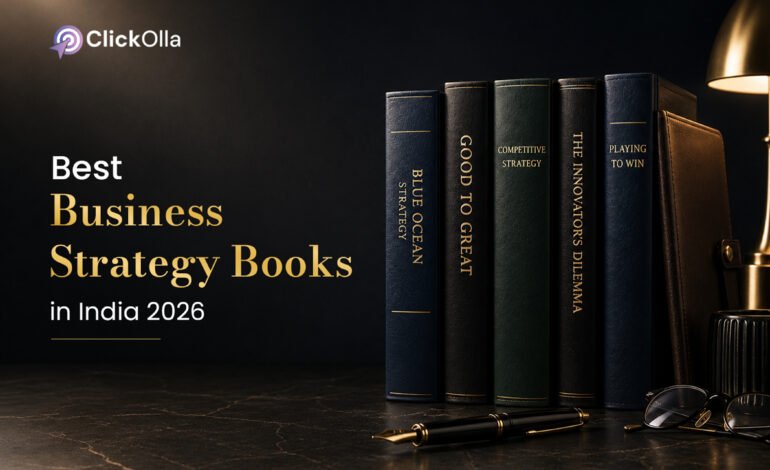
Best Business Strategy Books in India 2026

- PublishedJuly 7, 2026
Success in business is rarely built on technical knowledge alone. Whether you’re leading a startup, managing a team, preparing for an MBA, or advancing your corporate career, strong decision-making, communication, strategic thinking, and leadership skills are essential.
Books remain one of the most effective ways to learn from experienced executives, researchers, consultants, and entrepreneurs. A well-written business book can introduce practical frameworks, challenge assumptions, and provide new perspectives that readers can apply to real-world situations.
This comprehensive guide reviews five highly regarded books covering strategy, management, communication, career growth, and innovation:
Why Your Strategy Sucks: Build Smarter Frameworks to Win at Work and in Life

Book Reviewed
Many professionals believe strategy is something reserved for CEOs, business consultants, or large corporations. In reality, strategic thinking is valuable for almost everyone—from entrepreneurs and startup founders to managers, students, freelancers, and even individuals making important life decisions.
Why Your Strategy Sucks challenges the idea that strategy is simply about setting goals. Instead, it argues that effective strategy comes from building better decision-making frameworks that help people evaluate choices, allocate resources wisely, and respond to uncertainty.
Rather than offering generic motivational advice, the book focuses on structured thinking. It encourages readers to question assumptions, identify trade-offs, and develop repeatable approaches to solving complex problems.
Whether you’re planning a business expansion, leading a project, launching a startup, or making career decisions, the concepts presented aim to strengthen long-term thinking and improve the quality of everyday decisions.
The central theme of the book is that poor outcomes often result from weak decision-making processes rather than a lack of intelligence or effort.
Instead of relying on instinct alone, the book encourages readers to build practical frameworks that help answer questions such as:
- What problem are we actually trying to solve?
- What assumptions are we making?
- What alternatives exist?
- What trade-offs should we consider?
- How will today’s decisions affect future outcomes?
By focusing on these questions, readers learn to approach business and personal challenges more systematically.
The Practical MBA: A Guide to What You Don't Learn at B School

Book Reviewed
Business schools teach many essential concepts, including finance, marketing, operations, economics, and organizational behavior. However, many professionals discover that succeeding in the workplace also requires practical skills that are difficult to learn in a classroom.
The Practical MBA focuses on bridging this gap. Rather than replacing a formal MBA education, it complements it by discussing how business concepts can be applied in real organizations, projects, and leadership roles.
The book is written for readers who want practical business knowledge without relying solely on academic theory. Whether you’re an MBA student, startup founder, manager, consultant, or early-career professional, it aims to connect business fundamentals with everyday decision-making.
Instead of presenting isolated concepts, the book explores how different business functions work together to support organizational success.
The book explores many of the practical aspects of business that professionals encounter after entering the workforce.
Rather than focusing exclusively on academic definitions, it examines how organizations make decisions in areas such as:
- Finance
- Marketing
- Sales
- Operations
- Product management
- Leadership
- Strategy
- Organizational behavior
The goal is to help readers understand how these functions interact in real business environments.
How Business Storytelling Works: Increase Your Influence and Impact

Book Reviewed
Strong ideas alone are not always enough to influence people. In business, success often depends on how effectively those ideas are communicated. Whether you’re pitching a startup, presenting to senior leadership, leading a team meeting, negotiating with clients, or speaking at a conference, your ability to tell a clear and compelling story can significantly affect how your message is received.
How Business Storytelling Works explores the role of storytelling as a professional communication skill. Rather than focusing on fiction or entertainment, it demonstrates how structured narratives can make presentations more engaging, simplify complex ideas, and improve leadership communication.
The book emphasizes that storytelling is not about exaggeration or manipulation. Instead, it presents storytelling as a practical framework for organizing information, building clarity, and creating stronger connections with audiences.
For professionals who want to become more persuasive communicators, this book provides a structured introduction to business storytelling.
The book explains how storytelling can be used in professional settings to improve communication and engagement.
Instead of relying on long lists of facts or dense presentations, readers are encouraged to organize information into stories that are easier to understand and remember.
Topics include:
- Presentation structure
- Executive communication
- Leadership messaging
- Public speaking
- Customer communication
- Business influence
- Team alignment
- Persuasive communication
The emphasis is on helping professionals communicate ideas more effectively without sacrificing accuracy or professionalism.
The Career Edge: The Unwritten Rules of Success

Book Reviewed
Technical expertise can help professionals secure a job, but long-term career growth often depends on a wider set of skills. Communication, leadership, adaptability, collaboration, credibility, and the ability to navigate workplace dynamics all influence professional success.
Many of these skills are rarely taught in formal education. Instead, they are learned through experience, mentorship, observation, and continuous development.
The Career Edge focuses on these often-overlooked aspects of professional life. Drawing from leadership experience in a global corporate environment, the book explores practical lessons that help readers understand how successful professionals build trust, lead teams, manage change, and create long-term career momentum.
Rather than offering shortcuts or guaranteed formulas, the book emphasizes consistent habits, thoughtful decision-making, and professional conduct that can support career development over time.
The book explores the practical realities of building a successful career inside modern organizations.
Instead of concentrating only on promotions or performance reviews, it examines the behaviors and attitudes that contribute to long-term professional credibility.
Topics include:
- Leadership development
- Professional relationships
- Communication
- Workplace culture
- Career planning
- Continuous learning
- Decision-making
- Personal effectiveness
The emphasis is on sustainable career growth rather than quick success.
The New Geography of Innovation: The Global Contest for Breakthrough Technologies

Book Reviewed
Innovation has become one of the most important drivers of economic growth, business competitiveness, and national development. Advances in areas such as artificial intelligence, semiconductors, biotechnology, renewable energy, quantum computing, and advanced manufacturing are reshaping industries and influencing global markets.
The New Geography of Innovation explores how innovation ecosystems are evolving across different countries and regions. Rather than focusing only on technology itself, the book examines the broader factors that influence innovation, including research institutions, talent, investment, public policy, global supply chains, and international competition.
For business leaders, entrepreneurs, students, policymakers, and technology enthusiasts, the book offers a broader perspective on how breakthrough technologies emerge and why geography continues to play an important role in innovation.
The book examines how innovation develops through networks of organizations, institutions, investors, researchers, governments, and businesses.
Rather than treating innovation as isolated scientific discovery, it explores how multiple factors work together to create environments where new technologies can emerge and scale.
Key themes include:
- Innovation ecosystems
- Research and development (R&D)
- Global technology competition
- Entrepreneurship
- Investment
- Industrial policy
- Universities and research institutions
- Talent development
The discussion connects technological progress with economic and strategic considerations.
Frequently Asked Questions
1. Which is the best business strategy book?
The best choice depends on your goals. If you want practical strategic thinking and decision-making frameworks, Why Your Strategy Sucks is a strong option.
2. Which business book is best for beginners?
The Practical MBA is well suited to beginners because it introduces core business concepts in an accessible way.
3. Are business books worth reading?
Yes. Business books can introduce useful frameworks, case studies, and perspectives that support continuous learning and professional development.
4. How many business books should I read each year?
There is no fixed number. Consistently reading and applying what you learn is generally more valuable than focusing on quantity alone.
5. Can business books improve leadership skills?
They can provide ideas, frameworks, and examples that support leadership development when combined with practical experience.