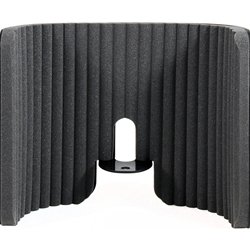
If you record vocals, podcasts, YouTube voice-overs, audiobooks, singing covers, dubbing, or instruments from a home studio, your room can have a major effect on the final recording.
Hard walls, windows, desks, ceilings, and empty spaces can create reflections and unwanted room ambience. A microphone isolation shield—also called a reflection filter, portable vocal booth, or vocal isolation screen—is designed to reduce some of those reflections around the microphone.
A microphone isolation shield is not the same thing as soundproofing an entire room.
This is one of the most important points for buyers.
A reflection filter is generally designed to control reflections and ambience immediately around the microphone. It cannot completely eliminate:
- Traffic noise
- Loud fans
- Construction noise
- People talking in another room
- Deep bass entering through walls
The sE Electronics RF-X, for example, uses a four-layer design consisting of a vented composite outer panel, wool fabric, an air gap, and an inner acoustic foam layer. The company positions it as a portable recording solution for vocals, guitars, drums, and other sources.
Primacoustic’s VoxGuard similarly uses an ABS shell combined with 1-inch high-density open-cell acoustic foam to reduce ambience around a microphone.
sE Electronics Reflexion Filter RF-X Review

Overview
The sE Electronics RF-X is one of the most recognizable products in this comparison.
It is designed as a portable vocal booth and uses technology derived from the company’s Reflexion Filter product line.
According to sE Electronics, the RF-X uses a four-layer acoustic filter design featuring:
- Outer vented composite panel
- Wool fabric layer
- Air gap
- Inner acoustic foam layer
The company states that this multi-layer construction is designed to work across the frequency spectrum and reduce unwanted sound coloration.
The RF-X is suitable for:
- Vocals
- Singing
- Voice-over
- Podcasting
- Acoustic guitar
- Electric guitar
- Drums
- Home studio recording
sE Electronics specifically describes the RF-X as an affordable version of its Reflexion Filter technology and recommends it for vocals and other recording applications
Audio Array AA-02 3-Panel Curved Isolation Shield Review
Overview
The Audio Array AA-02 is designed for creators looking for a more affordable microphone isolation solution.
It uses a three-panel curved design with foldable end panels and high-density multilayered foam.
According to Audio Array, the shield can be used on:
- Desks
- Tabletops
- Microphone stands
It includes mounting hardware compatible with both 3/8-inch and 5/8-inch mic stand threads.
A three-panel design is usually more compact than a five-panel shield.
This can make it useful for:
- Small desks
- Home offices
- Portable setups
- Beginner podcasting
- Voice-over work
The foldable side panels allow the user to adjust the angle depending on microphone placement.
DEVICE OF URBAN INFOTECH 5-Panel Isolation Shield Review
Overview
The Device of Urban Infotech option focuses on a familiar five-panel vocal booth design.
Compared with a basic three-panel reflection filter, five-panel designs can create a wider enclosure around the microphone.
This makes them potentially attractive for:
- Singing
- Voice-over
- Podcasting
- Dubbing
- Home studio vocals
The listed version also includes a pop filter, making it potentially useful for beginners building a recording setup from scratch.
More panels generally allow more coverage around the sides and rear of the microphone.
However, the number of panels alone does not guarantee better acoustic performance.
Other factors include:
- Foam thickness
- Material density
- Panel shape
- Microphone placement
- Distance from the shield
- Room acoustics
Primacoustic VoxGuard Review
Overview
The Primacoustic VoxGuard is positioned differently from typical folding metal-panel isolation shields.
The VoxGuard uses:
- ABS plastic outer shell
- 1-inch high-density open-cell acoustic foam
Primacoustic describes it as a portable acoustic screen designed to reduce ambient noise and room reflections around the microphone.
- Professional acoustic brand
- High-density acoustic foam
- ABS shell
- Desktop and stand-mounted versions
- Designed specifically for reducing local microphone ambience
- 75% recycled materials according to Primacoustic
DEVICE OF URBAN INFOTECH 5-Panel Isolation Shield Review
Overview
The second Device of Urban Infotech option is another five-panel microphone isolation shield aimed at home recording.
Five-panel designs are popular because they create a larger curved surface behind and around the microphone.
- Five-panel coverage
- Portable design
- Suitable for home recording
- Budget-friendly compared with premium acoustic brands
- Useful for basic vocal booth setups
- Product performance depends heavily on setup
- Does not eliminate external noise
- Larger footprint than compact shields
FAQ
What is a microphone isolation shield?
A microphone isolation shield is a portable acoustic accessory placed around or behind a microphone to help reduce nearby room reflections and ambience.
Does a microphone isolation shield soundproof a room?
No. It does not fully soundproof a room or block all external noise.
Which is the best microphone isolation shield for singing?
The sE Electronics RF-X is the strongest overall option in this comparison for serious vocal recording because of its dedicated four-layer acoustic design.
Is the sE Electronics RF-X good for home studios?
Yes. sE Electronics positions the RF-X as a portable vocal booth for home studio recording and lists applications including vocals, guitars and drums.
What is the difference between RF-X and a cheap foam shield?
The RF-X uses a four-layer acoustic structure rather than relying on a simple single foam surface.
Is Audio Array AA-02 good for podcasting?
Yes. Audio Array specifically lists podcasting, dubbing, recording, singing and acoustic recording among its intended use cases.