Best Political, Historical & Self-Culture Books: Complete Comparison & Buying Guide

- PublishedAugust 17, 2026
Choosing a serious nonfiction book is not always as simple as looking for the highest-rated title or the newest publication.
Some books are valuable because they explain a historical period. Others challenge the reader to reconsider political assumptions. Some examine the relationship between religion and politics, while others focus on monarchy, social values, personal character, or the author’s own political experiences.
Although these books can all be loosely connected to politics, religion, society, history, or personal values, they are not interchangeable.
A reader interested in Karl Barth will encounter theological and political analysis. A reader interested in the English Revolution will find a historical study of Puritanism and revolutionary politics. Someone interested in American political observations will encounter a memoir shaped by personal experience. A reader researching eighteenth-century Britain will find a scholarly collection about the Hanoverian monarchy. Meanwhile, Hillis’s classic work moves toward self-culture, morality, character, and social usefulness.
That makes these five books particularly interesting to compare.
This guide examines their subjects, historical contexts, intended readers, strengths, limitations, reading difficulty, themes, and practical buying considerations.
Karl Barth and Radical Politics

Book Overview
Karl Barth and Radical Politics, edited by George Hunsinger, explores the political dimensions of the thought of Swiss theologian Karl Barth.
The second edition was published by Cascade Books in 2017 and contains 264 pages according to Google Books. It expands upon the earlier edition with additional essays by Hunsinger addressing Barth’s theology in relation to human rights, liberation theology, and René Girard’s theories of violence and scapegoating.
The book is especially relevant for readers interested in the intersection of:
- Christian theology
- socialism
- political ethics
- human rights
- social justice
- radical political thought
- theological interpretations of modern society
One of the interesting aspects of the book is that it does not simply treat Karl Barth as a theologian isolated from political life.
Instead, the collection examines how Barth’s theology interacted with political and social questions.
The book’s historical background is particularly important.
Barth became associated with socialist politics early in his career, and his political thought developed alongside his theological work. A contemporary description of the book notes that Barth was known as the “Red Pastor” of Safenwil and that he joined the Social Democrats in 1915 while maintaining a critical relationship with socialist politics.
Not Peace But a Sword: The Political Theology of the English Revolution

Book Overview
Stephen Baskerville’s Not Peace But a Sword: The Political Theology of the English Revolution examines the relationship between Puritanism, religion and revolutionary politics during the English Revolution.
The expanded edition was published in 2018 by Pickwick Publications and is listed at 401 pages by the Folger Shakespeare Library.
The book is particularly concerned with the political implications of Puritan religious ideas.
Rather than treating the English Civil War solely as a constitutional or military conflict, Baskerville examines the intellectual and religious forces that helped shape revolutionary political consciousness.
The English Revolution is commonly associated with the political and military conflicts surrounding the English Civil War, the struggle between Parliament and Charles I, the execution of Charles I, the Commonwealth and the eventual Restoration.
But political institutions were only part of the story.
Religion was deeply intertwined with the political struggles of the period.
Puritanism affected:
- political arguments
- sermons
- social organization
- concepts of authority
- ideas of reform
- attitudes toward monarchy
- perceptions of moral responsibility
Baskerville’s book places these religious ideas near the center of the story.
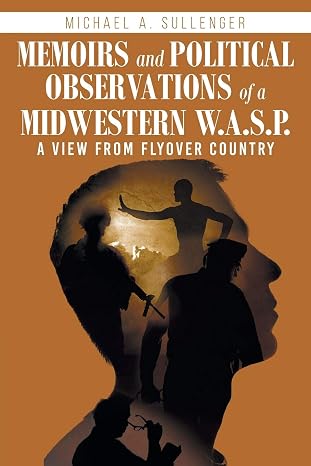
Memoirs and Political Observations of a Midwestern W.A.S.P.: A View from Flyover Country
Book Overview
Michael A. Sullenger’s Memoirs and Political Observations of a Midwestern W.A.S.P.: A View from Flyover Country takes a very different approach from the first two books.
Instead of being primarily an academic study of historical theology, it is a memoir combined with political and religious observations.
The book was published by Christian Faith Publishing in 2020. VitalSource lists the print ISBN as 9781098009809 and the ebook ISBN as 9781098009816.
The author’s perspective is rooted in his experiences growing up in Southern Indiana and his later education, travels and professional life.
The defining feature of this book is its personal perspective.
Sullenger does not approach politics solely as an academic observer.
Instead, his political observations emerge from:
- childhood
- family
- education
- Christian upbringing
- professional experiences
- American political culture
- personal beliefs
This gives the book a fundamentally different character from scholarly political history.
The Hanoverian Succession: Dynastic Politics and Monarchical Culture

Book Overview
The Hanoverian Succession: Dynastic Politics and Monarchical Culture, edited by Andreas Gestrich and Michael Schaich, is the most explicitly academic historical work in this comparison.
Published in 2015, the book examines the Hanoverian monarchy and the relationship between Britain and Hanover from the succession of George I through the later Hanoverian period.
Routledge describes the work as examining the 123-year union between Britain and the German electorate of Hanover, beginning in 1714.
The Hanoverian succession changed British political and dynastic history dramatically.
When George I became king in 1714, Britain entered a period in which its monarch was simultaneously connected to the electorate of Hanover.
The relationship lasted until 1837.
This was not merely a dynastic footnote.
It affected:
- monarchy
- religion
- political legitimacy
- military affairs
- international relations
- court culture
- colonial politics
- public representation
A Man's Value to Society: Studies in Self-Culture and Character
Book Overview
Newell Dwight Hillis’s A Man’s Value to Society: Studies in Self-Culture and Character is the oldest work in this comparison and the one most directly concerned with personal development.
The book was originally published in the late nineteenth century.
Project Gutenberg identifies the work as A Man’s Value to Society: Studies in Self Culture and Character, by Newell Dwight Hillis, and provides a freely accessible digital edition.
The University of Wooster’s digital collection describes the book as a study of culture intended to improve character, with themes involving individualism, morality and social contribution.
The term “self-culture” may sound unusual to a modern reader.
In the context of nineteenth-century writing, it generally refers to the deliberate development of one’s:
- intellect
- character
- habits
- moral qualities
- education
- judgment
- sense of responsibility
The central question is not simply:
FAQ
What is Karl Barth and Radical Politics about?
It is a collection edited by George Hunsinger examining the relationship between Karl Barth’s theology and radical political thought, including his relationship with socialism and later discussions involving human rights, liberation theology and violence.
Who edited Karl Barth and Radical Politics?
The second edition is edited by George Hunsinger.
What is Not Peace But a Sword about?
Stephen Baskerville’s book examines Puritanism and the religious and political ideas that contributed to the English Revolution. It pays particular attention to sermons and political theology.
Is Not Peace But a Sword an academic book?
Yes. It is best suited to readers interested in political theology, Puritanism, the English Revolution and intellectual history.
What is Memoirs and Political Observations of a Midwestern W.A.S.P. about?
It is a memoir and political commentary by Michael A. Sullenger that discusses his personal experiences and political observations through a Midwestern and Christian perspective.
Who wrote Memoirs and Political Observations of a Midwestern W.A.S.P.?
The author is Michael A. Sullenger.
What is The Hanoverian Succession about?
It examines the Hanoverian monarchy, dynastic politics, religious identity, political legitimacy, court culture and the relationship between Britain and Hanover.
Who edited The Hanoverian Succession?
The book was edited by Andreas Gestrich and Michael Schaich.
When did the Hanoverian succession begin?
The Hanoverian succession began in Britain in 1714 with George I and initiated a 123-year union between Britain and Hanover.
What is A Man’s Value to Society about?
Newell Dwight Hillis’s book explores self-culture, character, morality, individual development and the contribution individuals can make to society.